

Every grower faces this crucial question: "How much area can my roll of drip irrigation tape actually cover?" Getting this right is essential for building an efficient and cost-effective irrigation system.
This guide'll give you a clear, step-by-step method for accurate calculations. The final coverage number isn't fixed. It changes based on drip irrigation tape specifications, your crop choice, field shape, and how you design your system.
This section gives you the foundation for planning your irrigation layout. It begins with a simple formula and a hands-on example.
The basic formula for calculating potential coverage is simple: Total Area=Total Tape Length × Row Spacing.
Here, Total Area is measured in square meters (m²). Total Tape Length is your roll's length in meters (m). Row Spacing is the distance between crop rows, also in meters (m).
For conversions, remember these numbers: 1 Acre equals about 4047 square meters. 1 Hectare equals 10,000 square meters. 1 Chinese Mu equals about 667 square meters.

Example: 1,500-Meter Roll
Let's use a common example. We have a standard 1,500-meter roll of drip irrigation tape. How much area can it irrigate?
The answer depends completely on your planned row spacing.
The table below shows how row spacing dramatically affects total drip irrigation tape length coverage.
|
|
|
|
|
|
|
50 cm
|
0.5m |
750 m²
|
~0.19 acres
|
~1.12 mu
|
|
75 cm
|
0.75m |
1125 m²
|
~0.28 acres
|
~1.69 mu
|
|
100 cm (1m)
|
1.0m | 1500 m² |
~0.37 acres
|
~2.25 mu
|
|
120 cm
|
1.2m | 1800 m² |
~0.44 acres
|
~2.70 mu
|
Wider row spacing lets a single roll cover more total area. But this initial calculation is just the starting point for professional system design.
Understanding the technical details on drip tape packaging is crucial. These specifications determine performance, durability, and whether the tape suits your specific needs.
1. Emitter Spacing Explained
Emitter spacing is the distance between water outlets along the tape. Common spacings are 20cm, 30cm, or 40cm.
Choosing the right spacing balances soil type and crop type.
For soil: Use closer spacing (like 20cm) in sandy soils so wetted patterns overlap. Wider spacing (like 40cm) works for clay soils, which spread water more horizontally.
For crops: Dense plantings like lettuce or onions need closer emitters. Widely spaced crops like corn or tomatoes can use wider emitter spacing that matches their root zones.
2. Understanding Flow Rate
Emitter flow rate is measured in Liters Per Hour (LPH) or Gallons Per Hour (GPH). It's the heartbeat of your system. This defines how much water each emitter releases over time.
Typical flow rates range from low (0.5-1.0 LPH) to medium (1.0-2.0 LPH) to high (over 2.0 LPH).
The main trade-off is irrigation time versus system demand. Higher flow rates water crops faster but need a stronger water source, pump, and mainlines to supply the necessary volume.
3. Wall Thickness and Diameter
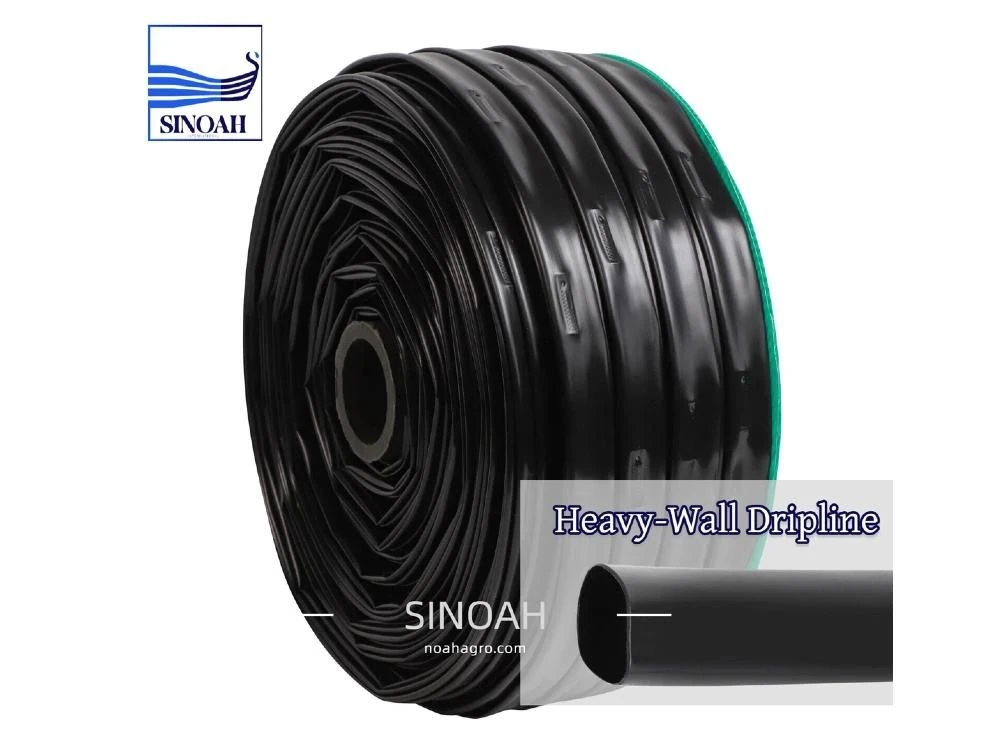
Wall thickness is measured in mil (one-thousandth of an inch). It directly indicates the tape's durability and expected lifespan.
Tapes with 5-8 mil thickness are generally single-season products, ideal for annuals. Tapes in the 10-15 mil range are more robust. They suit multi-season use or fields where you plan to retrieve and reuse the tape.
The tape's diameter, typically 16mm or 22mm, directly affects maximum run length before pressure and flow uniformity drop significantly. Larger diameter tape can carry more water over longer distances.
Adjusting for Real-World Factors
The theoretical calculation is just a starting point. To create a truly effective system, we must adjust for variables present in every field. These factors will refine your estimate of true drip irrigation tape length coverage.
◆
Different crops have vastly different water needs. This directly impacts the total area you can irrigate simultaneously.
We can group crops by their general water demand. Garlic and onions have relatively low needs. Corn and beans fall into a medium-need category. High-demand crops include tomatoes, melons, and alfalfa.
This is critical: a water source that can support 10 acres of onions might only support 5 acres of melons. Your system's capacity, not just the amount of tape you own, limits your effective coverage.
◆
How water interacts with your field's physical characteristics is a primary consideration. Soil type and topography dictate how water moves both on and below the surface.
In sandy soil, water infiltrates quickly and vertically. This requires higher flow rates or closer emitter spacing to create a continuous wetted strip along the crop row.
Loam soil is often considered ideal. It provides a good balance of vertical infiltration and horizontal spread.
In clay soil, infiltration is slow, creating risk of surface ponding and runoff. Lower flow rate emitters are essential to give soil time to absorb the water.
Topography also plays a vital role. Irrigating uphill requires additional pressure to push water against gravity. This reduces the maximum allowable run length of your drip tape. Conversely, downhill runs can increase pressure, often requiring pressure-compensating emitters or regulators to prevent bursting lines at the bottom of slopes.

◆
Every drip irrigation tape is designed to operate within a specific pressure range, often between 8 and 15 PSI (0.55 to 1.03 bar). Operating below this range results in poor uniformity. Exceeding it can cause fittings to leak or tape to rupture.
More importantly, your pump and mainlines must supply the total flow rate required for the area you plan to irrigate at one time. This is a non-negotiable limit on your operational coverage.
You can calculate this with a simple formula: Total Flow Needed=(Total Tape Length / Emitter Spacing) × Emitter Flow Rate. This number tells you if your water source and pump are adequate for your plan. If not, you must divide your field into smaller irrigation zones.
◆
Drip irrigation is highly efficient, typically achieving 90-95% water application efficiency. This means 90-95% of water leaving the emitter reaches the plant's root zone.
However, this isn't 100%. To account for minor losses from evaporation or deep percolation below the root zone, you must slightly over-allocate water. If calculations show a crop needs 10 liters of water, applying 10.5 to 11 liters ensures its needs are fully met. This small adjustment can affect the total sustainable area for a water-limited system.
Theory is valuable, but practical application is where mastery is built. Here, we combine all the preceding information into a real-world project. This demonstrates how these principles work together.
The 2-Acre Cornfield Scenario

We were tasked with designing a drip system for a 2-acre cornfield. This translates to approximately 8,094 square meters. The field had loam soil with a gentle, consistent 1% slope.
The goal was to determine required drip tape amounts and design a system supported by the grower's existing 10,000 LPH (Liters Per Hour) well pump.
We approached the design with a systematic, four-step process.
Step 1 was the initial calculation. Corn is commonly planted with 75cm (0.75m) row spacing. Required tape length was calculated as 8,094 m² / 0.75m, which equals 10,792 meters of tape. Using standard 1,500-meter rolls, this project would require approximately 8 rolls of drip tape.
Step 2 involved specification selection. Given the loam soil and corn's water needs, we chose 16mm diameter tape. We selected 30cm emitter spacing to ensure good coverage along the row and a moderate 1.2 LPH flow rate to balance irrigation time and system demand.
Step 3 was the critical system check. We calculated total flow rate needed if the entire field were irrigated at once: (10,792m / 0.3m spacing) × 1.2 LPH per emitter=43,168 LPH. This number was over four times the available 10,000 LPH pump capacity.
Step 4 was creating a zoning solution. The field was divided into 5 manageable irrigation zones. Each zone required approximately 8,600 LPH, a flow rate comfortably within the pump's capacity. The system would operate by irrigating one zone at a time, sequentially, until the entire field was watered.
The zoned system was implemented successfully. This led to uniform crop growth and efficient water use across the entire 2-acre field.
For this project, we recommended 15 mil wall thickness. This multi-season tape represented a higher initial investment but delivered superior long-term value by reducing annual labor costs associated with installing and removing thinner, single-season tapes.
The decision to invest in valves and sub-mainlines for zoning was crucial. It allowed the grower to use their existing, smaller pump, saving significant capital expenditure on a larger pump and power unit. We also advised using a light drip irrigation cover of straw mulch between rows to further reduce surface evaporation.
Strategic Long-Term Planning
A successful irrigation system isn't just about a single season. It involves forward-thinking about durability, cost-effectiveness, and compliance over the long term.
Your drip tape's wall thickness (mil) directly correlates to its expected lifespan and resistance to mechanical damage and insects.
An economic calculation is necessary. Cheaper, thin-wall tape (like 6 mil) might seem cost-effective for a single season of high-value annual crops. However, for perennial crops or situations where labor for annual replacement is expensive, more durable, thick-wall tape (like 15 mil) often provides lower total cost of ownership over several years.
In an increasing number of regions, agricultural water use is regulated, metered, or allocated. This places a premium on efficiency.
A well-designed drip irrigation system, planned using principles in this guide, is the most effective tool for maximizing crop yield while adhering to strict water allocations. It ensures every drop is counted and delivered where it's needed most.
True drip irrigation tape length coverage isn't a single number found on a specification sheet. It's the result of a dynamic calculation that balances your resources with your goals.
Start with the basic formula. Then methodically adjust for tape specifications, crop needs, soil, terrain, and your system's hydraulic capacity. This moves you from a rough estimate to a precise, actionable plan. Using this comprehensive approach, any grower can design and implement a truly efficient, effective, and sustainable irrigation system.